Thursday, November 15, 2012

Kicking it Old School: Babel-17

I've got another read here that falls into the Kicking it Old School category of things.  This time around, I went for Samuel R. Delany's Babel-17.  I've been wanting to read something by Delany for a while now, but Dhalgren seems too intimidating and Triton seemed less accessible as a first read for an author who is new to me.  So I settled on Babel-17.

In Babel-17 there's a very basic plot dilemma going on;  The good guys, also known as the Earth People's Alliance, are losing a war to alien invaders.  The tricky part is that the aliens are capable of communicating in a language that only they can understand, which makes it really tough for the good guys to defend themselves and plan for their enemy's next moves.  Enter cosmic poetess, aikido blackbelt, star captain, and master of languages, Rydra Wong.  The Earthpeople's Alliance enlists Wong in hopes that she can learn the alien language, and thus help her people win the war.

In order to do so,  Wong puts together a crew to man a starship, and travels the stars dig up bits of the language and piece together meaning in hopes of helping in the war efforts. Along the way, she discovers that Babel-17 can actually alter the way a person thinks, thus making those who hear it engage in acts of sabotage and destruction.

It was pretty interesting to read Babel-17, after reading China Mieville's Embassytown, as they are both novels that explore language and how language makes people think and act.  It was also interesting to see how each author took very different approaches to exploring language.  It was also interesting to see how each author, despite taking separate approaches to exploring language, failed to capture my interest in the topic at hand.

I guess I'm just not all that into reading about language.

Though most of the best qualities of this book were overshadowed by the dullness of the subject matter, Delany did have some cool ideas.  Wong wasn't my favorite character ever, not by a long shot.  She was just too damn good at everything.  It was kinda annoying.  Perfection isn't really something I find all that interesting.  Delany's vision of an intergalactic future was pretty cool though.  Many of the humans all had significant body enhancements, which made them resemble human-animal hybrids, which I though was pretty cool, and body enhancements are probably a few logical steps away from tattoos and piercings.

Wong and her crew also got caught in some sort of space-time slipstream where they traveled on the edge of reality, which I found absolutely fascinating...it was sorta a hard concept to understand though and, if you couldn't tell from my description, hard to describe.  But still, I enjoyed trying to wrap my brain around the concept.  Delany also wrote some pretty well orchestrated action scenes, and delivered some tense moments, so even though I didn't totally enjoy this book, I have a good feeling I might click with one of his other works.

I think I'm done reading books that explore language for a while though.

Before I wrap this one up, I just want to point out that ridiculous cover.  How awesomely bad is that?  I'm pretty sure that his meant to Wong, and one of her crew members, but Wong wasn't a blonde-haired white woman, and I didn't really picture the altered humans looking that goofy.  Anyway, this was one of my least successful Kicking it Old School reads, but I'm up for some more Delany in the future.

Grade:  6.5 Teddy Ruxpins

Monday, November 12, 2012

Graphic Novel Review: Like a Sniper Lining Up His Shot

The Jacques Tardi comics I've read so far have been bonafide hits for me.  Just check out my reviews for It Was the War of the Trenches and The Arctic Marauder if you don't believe me.  I've had such good luck with Tardi's work that I've gone as far as stockpiling yet-to-be-read Tardi comics on my shelf, so that they are readily available should the desire to read some incredible French comics strike.

When the desire struck me this time around, I picked up Like a Sniper Lining Up His Shot.  This is the first Jacques Tardi comic I've read where he's not the sole artist working on the graphic novel.    For Sniper he adapted a novel written by French writer Jean-Patrick Manchette.

The story follows a hardboiled bad-ass by the name of Martin Terrier, who's a mercenary-turned-assassin.  On the opening page of the graphic novel, he executes (pun intended) what he plans on being his last ever job in the killer for hire business.  From there he plans to take his savings, collect a long-lost lady love, and retire to some discreet, and warm, location to live out the rest of his days.

The thing is, his employers aren't too happy with his decision, and to make matters worse, old enemies start popping up in Terrier's life.  Before too long, Terrier finds himself reluctantly dragged back into the life he was trying to leave behind.

Like a Sniper Lining Up His Shot definitely has a plot with a lot of wear on it.  We've all read a book or seen a movie where some tired old assassin is gonna do just one last job, then call it quits and retire with a lady somewhere warm.  Sure, it makes for a decent story but it felt a little tired out on this most recent go-round.

I think what makes the "Just one last job" plot-type a success, is a character that the reader, or viewer can root for, someone you wish could have a chance at a better life.  Well, that's not really the case here.  Terrier is a bit of a seedy bastard, definitely on the unsavory side of things, so it was hard for me to wish him well.  If you can get past his cold-heartedness, and his penchant for brutal violence, you could certainly root for the guy based on how damn resourceful he is in a pinch.  By "resourceful" I mean not in the  MacGyver sense, I mean resourceful in that he can decisively handle situations where he's being tailed, held at gunpoint, being back-stabbed...that kind of stuff.  He's pretty much a cold-blooded bad-ass when it comes down to it.

The novel this graphic novel is based on was written by Jean-Patrick Manchette and Jacques Tardi handled the adaptation from book to comic. It is an adaptation that feels a little rough around the edges at times.  I think it is always hard to adapt a book into a graphic novel, the written word doesn't necessarily always translate that smoothly into words and pictures.  You definitely need a novel high on visuals in order to make the adaptation work, and even when you do have that situation, like here with Sniper, there are always some crucial parts that don't adapt that well to the new format.  This results in pages that are way too text heavy for the comics medium, or word bubbles that awkwardly contain a paragraph worth of text.

Like a Sniper Lining Up His Shot definitely fell victim to that text-onslaught, particularly towards the end. The times when Sniper loses that harmony between words and art always jarred me out of my reading groove, and forced me into this uncomfortable place where the words and art were at odds with each other. As you might imagine, this definitely took away from the overall experience.

The greatest piece of this graphic novel was easily Tardi's art.  As always with a Tardi graphic novel, I was very impressed with the quality on the art front.  Tardi's work here lacks some of the raw emotion of It was the War of the Trenches and some of stylistic flair of The Arctic Marauder, but it is still quality work.  Unlike my other two Tardi reads, this one is much more action packed, and I was impressed to see that Tardi could make action scenes come to life so fluidly.  Tardi's black and white art is definitely a spot-on match for this gritty crime story.

Even though Like a Sniper Lining Up His Shot has a plot that isn't doing anything new, and features an adaptation that doesn't translate so well at times, this is still an enjoyable graphic novel.  There was enough scenes of action and intrigue to make me forget my plot gripes every now and again, and as always, Tardi's art was a pleasure to drink in.  This is probably my least favorite Jacques Tardi graphic novel yet, but despite a few warts, I still enjoyed it.

Grade: C+

Saturday, November 10, 2012

Comic Quickies: Let the Phantasmagoria Commence

The Zaucer of Zilk #1: Wanna talk about a book that leaps off the shelves? It was hard to not notice The Zaucer of Zilk when I walked into the comic shop a few weeks ago.  With a cover more vivid than the technicolor dreamcoat, I just had to pick this up and flip through it.  The inside of the comic was on par with the cover, and the art style was certainly eye-catching and offered up some incredibly psychedelic and mind-bending illustrations. (My lady said it looked like one of her old Lisa Frank stickers!)  The art seemed to be completely different from anything else on the shelves, so I decided to pick it up and give it a read.

The Zaucer of Zilk is co-written and illustrated by Brendan McCarthy, a guy whose writing is as far out as his art.  The story follows a young man who wanders into a candy shop, steals some candy, eats it, and winds up in a strange, psychedelic fantasy land where he holds the noble title of Zaucer of Zilk.  Along with a magical wand and some strange companions, The Zaucer finds himself caught in an elaborate trap set up by his enemy, the Errol of Raine, who's trying to steal the Zaucer's magic wand.  Along the way a lot of really strange, weird and oddball shit goes on.

The Zaucer of Zilk has got to be the weirdest thing I've ever read in my life, yet it was still pretty entertaining.  McCarthy can draw some really weird shit, but I gotta say, I enjoyed taking my time with the art and soaking it all in.  Just out of sheer curiosity, I'll be looking forward to seeing what happens next with the Zaucer.

Godzilla The Half Century War #3: I don't claim to be a Godzilla fan, which is kinda strange given my affinity for monsters, but god damn, James Stokoe has created one absolutely amazing Godzilla comic.  You don't have to look any further than the cover to know that you'll be getting some absolutely amazing artwork when you buy this comic, but you're also getting a really amazing story.

Stokoe's story follows a team of soldiers who specialize in trying to reduce the amount of death and destruction Godzilla wreaks whenever and wherever he happens to pop up across the globe.  He doesn't come around all that often, but when he does, the AMF is there. So far Godzilla has cropped up in WWII Japan, Vietnam during the Vietnam war, and In this issue, in Accra, Ghana in 1975.  In fact, a shit ton of other monsters are on hand as well, and they all appear to be drawn there by some sort of homing beacon.

Everything is dialed up to eleven in this issue, the monster fights, action, destruction, and incredible art are all off the chain here.  Stokoe pretty much puts on a clinic for how to make a fucking incredible comic.  There's more going on in one splash page here then most other comics combined.  Reading Godzilla The Half Century War is a treat.

Multiple Warheads #1:  Rounding out this comic quickies where amazing art rules the day, is Brandon Graham's latest, Multiple Warheads.  This dude was very impressive with King City, and his work on Prophet has been awesome as well.  A year ago, I had never read a single thing by the guy and now I'd easily place him as one of my top five favorite comic creators.

Multiple Warheads is a comic I've been eagerly awaiting for a while now, especially since Graham handles all the comic creating tasks, and I've been eager to see him unleash his comic creating skills on a title that is 100% his own.

Well, my wish was granted.  This first issue of Multiple Warheads weighs in at a whopping 48 pages of Brandon Graham comic-creatin' genius.  The story follows a young couple, Sexica and Nikoli who are on a road trip together after their home was destroyed in a bombing.  Sexica was once an organ smuggler, and sewed a werewolf penis on poor Nikoli.  Now he has dreams of the wolf's past life.  Then there's also Nura, another organ smuggler, who also appears to be pretty handy with the sword she has strapped to her back.  It's unclear exactly what everyone is doing here and why, but as I learned from reading King City, Graham isn't the kind of guy to worry much about plot, and instead prefers to just let the story go wherever it may.

I'm up for whatever as long as Graham keeps cranking out the level of amazingness he produced here.  This is one absolutely beautiful looking comic, and a lot of fun to read too.  Graham is a modern master of the pun, and each page is laced with at least one great pun, if not more.  My favorite was the misogynist parlor.

I think my favorite thing about this comic is the fact that all signs point to the fact that Graham is making exactly the comic/art he wants to be making, without having to make any compromises.  That is a rare thing, and Multiple Warheads is a better comic for that fact.  This is an absolute must read.

Thursday, November 8, 2012

Book Review: Kafka on the Shore

I consider myself to be a fairly well-read guy, but that doesn't mean that there aren't a few thousand gaping holes in my reading resume.  Until very recently, Haruki Murakami represented one of the largest holes in said resume.

I honestly didn't really know where to start with Murakami, I'd heard friends and book reviewers mention a few of his titles, so I just grabbed a few of the familiar sounding titles off the shelf at the bookstore, read the blurbs on the back of the book, and settled on Kaka on the Shore  based on the fact that it promised talking cats and a couple of protagonists who aren't the typical folks I come across in my usual reading habits.

Kafka on the Shore is a novel the derives much of it's power from the two protagonists.  The first is a fifteen year old boy named Kafka, who at the start of the book, runs away from home for three good reasons: His Dad is an asshole, he's escaping a creepy oedipal prophecy, and he's searching for his long-lost mother and sister. The last reason is sorta at odds with the second reason, but hey, he's fifteen.  As far as most fifteen year old's go, Kafka is one incredibly well put together young man.  He's mentally regimented, he's clever and resourceful...all which help him get by in a world where he has no one to help him on his way.  The kicker is, like any fifteen year-old striving for self-sufficiency would find, he's incredibly vulnerable, and completely lacking in the life experiences and common sense know-how that comes with growing up, and is essential to "making it" in the real world.  This combination of strengths and weaknesses makes Kafka a very interesting person to read about.

The other main character is an aging man, Nakata, who lost much of his cognitive ability during a strange episode during his youth which left him in a coma for an extended length of time.  Nakata has been getting by thanks to a government subsidy, and his freelance cat finding side work.  Nakata excels at finding people's missing cats due mostly to the fact that he has the ability to speak to cats.  It is the search for one particular missing cat that leads Nakata on a path towards life changing events, and inextricably, towards Kafka.

Both narrative paths were quite interesting to read and both Kafka's and Nakata's paths introduced a number of other characters that were equally interesting and amazingly well developed.

The characters in Kafka on the Shore are amazingly well written.  Murakami is flat out one of the very best character writers I've ever read.  I felt like I could see each and every character so clearly in my mind's eye. While reading this book, I had an incredibly clear picture of what each character looked like, what sort of facial expressions they made, their idiosyncrasies and more. Each character feels so life-like it was amazing.  What's more amazing is that Murakami pulled this off and I have no clue how he did it.  What I'm saying is that it was nothing obvious or overt that made these characters stand out. It is hard to put my finger on just how Murakami pulls this off, but the fact is he writes some incredibly fleshed out and "real" characters in a very subtle way.

On top of great characters, Kafka on the Shore is a book this is easy to get lost in.  This is a novel that has incredibly blurry lines between reality and the fantastical.  It challenges the reader to decide what is real, what is imagined, and what is possible within the bounds of reality that is represented in the story.

I believe everyone's journey from youth into adulthood has a little bit of magic in it no matter what.  There's no doubt that relationships, love and life can take on a magical quality during those times, and Murakami takes this phenomenon a step further with Kafka's coming of age story.  There's some beautiful moments, some brutal moments, and some that are just flat out weird.  This blend of fantasy-literature/magical realism made for an enjoyable read.

Despite these great qualities, Kafka on the Shore has been sitting in my review queue for some time, getting actively ignored in favor of books that are easier for me to talk about.  Obviously, I really enjoyed this book, but it's one of those books that is hard for me to articulate why I found it so enjoyable. Even the things I just wrote about ring hollow when I think about how I really feel about this book in my heart and mind.  Sure, this is a fantastic book on a technical level.  And it's a great book on a readability level.  But it's frustrating when I can't point to why I like something so much.  Maybe it's that combination of technical skill and storytelling that makes this book feel so different and special to me.  Whatever it is, reading Kafka on the Shore sorta feels like receiving a really awesome gift.

My shortcomings as a reviewer aside, Kafka on the Shore is a book that shouldn't be missed.

Grade: A+


Sunday, November 4, 2012

Short Run Comics Fest

Yesterday, Seattle played host to another great comic event,  Short Run. A brand-new comics event, Short Run is a showcase of comics, zines, art books, animation and more...yes, I just copied that from the poster.  Basically it is a bunch of indie and underground comic creators coming together to put on a free event to showcase their artistic talents.

There were a number of comic creators on hand that I was interested in meeting and seeing their work, plus the event was FREE so it was pretty much no-brainer for me.  There was also a lunch counter nearby that serves delicious fried chicken sammys so I was doubly excited to make the trip!

Short Run was definitely the most humble of any comic related event I've been to this year, but it was certainly well attended.   Plenty of folks were on hand, to the point where the aisles felt pretty crammed and were hard to maneuver around.  

When I arrived on the scene, I made a bee-line to Theo Ellsworth's table, as he was the one guy I was most looking forward to seeing.  Ellsworth is one of those comics creators whose art is hyper-detailed, incredibly imaginative and monster-tastic.   Check out the guy's blog for a glimpse at his stuff...I might have a new favorite artist.  I picked up his latest work, The Understanding Monster book one.  I'm looking forward to giving that one a read.  I also picked up a boxed set of Alec Longstreth's mini-comics, which contains all five issues of Basewood, his fantasy tales. Here's a pic of my modest haul for the day:


Overall, I'd say that the event was pretty successful, especially given the fact that this was Shot Run's first year.  There was a pretty big range of folks there, from people who are literally printing and stapling their stuff together on their own, to folks how have "made it" and been published by either smaller independent publishers like Secret Acres, or big dogs like Fantagraphics.  Either way, it was cool to see the entire spectrum of the independent comics industry on hand.  

Judging from the amount of fans on hand, and the amount of comic-makers in the house, I'd say it's a pretty safe bet that Short Run will be back again next year.  I enjoyed the show, and would love to see it grow into a yearly tradition.  

Saturday, November 3, 2012

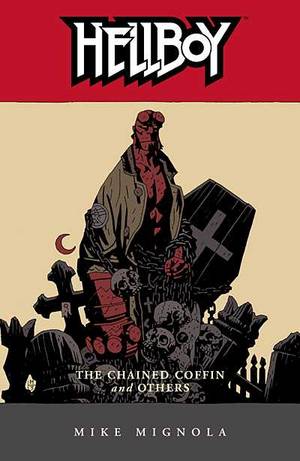
Comic Review: Hellboy Vol. 3 The Chained Coffin and Other Stories

I just don't know how to feel about Hellboy.  On the one hand, I really enjoy the art, and to a certain extent, I enjoy the stories, which delve into the myths and folklore of various cultures from around the world.  On the other hand though, is the fact that I've started to notice a trend.  That trend is this: Hellboy investigates some sort of creepy castle, or ancient ruin, then gets in a big ol' punch up with some sort of giant beast. Cue up the next story, and it is pretty much the same thing all over again.

I've said in the past that I love me some monsters and beasts, and that is true. I love 'em.  And yes, Hellboy delivers a shit ton of great monsters and beasts...what it all boils down to I guess to too much of a good thing.

The Chained Coffin and Other Stories follows the trend I mention above, except this time that trend is magnified since this is a collection of Hellboy short comics.  The thing is, while that trend might be magnified here, everything else that is so awesome about Hellboy is also magnified, so it all sorta comes out as a wash.

I think my favorite thing about this third volume of Hellboy is that Mignola draws much of his inspiration for the comics in this collection from a variety of folklore from around the world.  He essentially takes a bunch of really cool and obscure folklore that he dug up, and adapted it for the world he has created.  The results are a lot of fun to read.  The connections to myth and folklore are initially what drew me to the Hellboy series in the first place, so I really enjoyed getting a heavy dose of the stuff all packed into this volume.

As always, Mike Mignola's art is really impressive.  There's something to be said for the writer/artist which is a rare beast in comics, and it is even more rare to find one who can deliver truly great art, and Mignola certainly does that.  His art is some of the moodiest stuff I've ever laid eyes on.  I'm deeply impressed with his ability to set the mood and tone of his stories with his art.  It's an awesome skill to have at his disposal as an artist.

It's not so often that a comic artist's work breaks into the mainstream pop culture conscience, but I feel like Mignola has managed to do just that.  Hellboy has a look and feel that even the non-comic reading layperson recognizes.  Not that pop culture notoriety is something really special, but it is a testament to the fact that Mignola's art is unique and attention grabbing.

All told, I think the sheer volume of stories, especially ones steeped in folklore, makes this my favorite Hellboy volume yet.  I can't say that I'm totally enamored of this series; To be honest, I'm reading the Hellboy stuff more out of a desire to lay down the groundwork so that I can move on to the B.P.R.D. series, which I feel like holds more of an attraction to me.  Still, Hellboy isn't totally unenjoyable, it just doesn't completely float my boat.  Perhaps, as I delve deeper into the series, I'll come to like it more.  For now, I'll just pass on the word that The Chained Coffin and Other Stories is the best stuff I've read so far in this series.

Grade: B

Thursday, November 1, 2012

Comic Quickie: Lose #4

Michael DeForge is one of those artists who is well loved by other artists.  It seems like whenever I read or listen to an interview with any indie comic artist, they always mention DeForge as one of their favorite artists.

Because of this fact, I've been eager to get my hands on some sort of published comic by the man.  It turns out those are hard to come by though.  I was looking for something more substantial than comics of the anthologized, or mini comics variety, which led me towards his lengthier work; his four issues of Lose.  Lose is published by Koyama Press, a publishing company that is quietly putting out some great indie comics.

Apparently, DeForge is making an impact, because issues one through three of Lose were completely sold out. Undeterred, I bought the fourth and most recent issue, also known as the "fashion issue".

There are three different comic stories contained in this issue, all of which I found to be a perplexing mix of interesting stories that wander deeply into the realms of weirdness pretty quickly.  The first story involves a young man who falls victim to a strange communicable disease which covers his body in S&M attire which also appears to be some sort of symbiosis.  From there, there's a story about the fashions of Canadian royalty, and story where every living thing, both humans and animals, in a small Canadian town have the same face...Staceyface

DeForge may be an artist's artist, but I'm not so sure he's an artist that matches my tastes.  Frankly, after reading Lose #4, I'm slightly confused as to what the fuss is all about.  DeForge's art is different...possibly even "fresh", and interesting to look at, but it's not the most accessible style.  Additionally, his stories all had moments of greatness, yet they quickly to dipped into levels of weirdness that was difficult to digest as a reader.

Maybe I'm missing something from this reading experience, maybe I'm not well versed enough in indie and underground comics to fully grasp the art and concepts...or maybe not. Forty-eight pages worth of material is a decent litmus test though.  The thing is, I'm not completely ready to write DeForge off. Despite feeling like I don't see what all the fuss is about, I still enjoyed the stories and the weirdness, just to a lesser degree than I expected given all the great things I've heard and read about the guy.  I'd like to see what else he's created in the world of comics, and form a more solid opinion.  Until then, I'll remain unconvinced of his awesomeness.